September 14th, 2004
Hi Mom,
The dives are going well. I’m O.K. but I screwed up a bit while diving the U.S.S. Wisconsin this weekend. It wasn’t just one big mistake but several small ones leading up to some bigger ones. I’ll fill you in. The Buccaneers dive club out of Pirates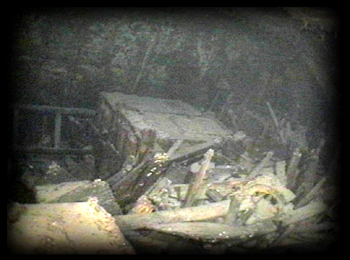 Cove Dive Shop had a club charter scheduled
for this last weekend. Jane and I signed up. I wanted to shoot some updated
(better) video of the 1929 cars inside the port cargo hold. Also while looking
at video I shot in the other cargo hold last fall, I noticed two side by side
wooden boxes. Both looked to be still closed and untouched. If they could
be easily opened, we were curious to see what was in them. All winter, while
looking at the video stills, we speculated on what could be in there, everything
from gold bars and wine bottles to car springs and 75 year old cheese. Knowing
it was illegal to bring anything up; I was personally rooting for the cheese.
Being that the wreck was at 130 feet I figured we could do two dives on one
set of doubles and 40 cubic feet of 50% nitrox to speed up our decompression.
After going into the garage and finding my already filled 50% stage bottle,
I took the regs off of it, reanalyzed the oxygen percentage just to be sure
it was correct and reset up the regulators. I set up my doubles, rechecked
the fill and loaded my gear into the truck. After grabbing my camera and some
coffee I headed down to Kenosha. Jane was going to meet me there as she was
already in town with her boyfriend.
Cove Dive Shop had a club charter scheduled
for this last weekend. Jane and I signed up. I wanted to shoot some updated
(better) video of the 1929 cars inside the port cargo hold. Also while looking
at video I shot in the other cargo hold last fall, I noticed two side by side
wooden boxes. Both looked to be still closed and untouched. If they could
be easily opened, we were curious to see what was in them. All winter, while
looking at the video stills, we speculated on what could be in there, everything
from gold bars and wine bottles to car springs and 75 year old cheese. Knowing
it was illegal to bring anything up; I was personally rooting for the cheese.
Being that the wreck was at 130 feet I figured we could do two dives on one
set of doubles and 40 cubic feet of 50% nitrox to speed up our decompression.
After going into the garage and finding my already filled 50% stage bottle,
I took the regs off of it, reanalyzed the oxygen percentage just to be sure
it was correct and reset up the regulators. I set up my doubles, rechecked
the fill and loaded my gear into the truck. After grabbing my camera and some
coffee I headed down to Kenosha. Jane was going to meet me there as she was
already in town with her boyfriend.
I arrived early for the charter and
spent time briefly going over our dive plans. I pretty much had it figured
out; I just needed to know if Jane wanted to do a long first dive and short
second dive or two identical dive profiles. Once she showed up we started
discussing it while loading the gear onto the boat. Around that time she introduced
me to a diver named Carl. He asked if he could dive with us, since he was
planning to do a similar dive with 50% as a deco gas. I asked if there was
anything special he wanted to see on the wreck and he replied that he had
never seen the cars and would like to. It sounded good as that was part of
our mission too. He mentioned that his SAC rate was high so we would need
to plan the dive using more gas per minute. Because of physics, when a diver
breathes air or gas underwater, the amount he takes in grows as he gets deeper.
If you keep track of this over a few dives, a divers SAC rate, (Surface Air
Consumption), or the amount of gas that a diver breathes in general on the
surface can be calculated. Without getting too technical, you can then use
that number to plan the amount of air or gas you need for a future dive. This
wouldn’t be a problem for our dives because we weren’t planning to push the
limits. Once we were underway and heading to the dive site we agreed to do
one 25 minute dive then probably a second 20 minute dive. We would have to
see how long our surface interval in between dives would be before putting
too much planning into the second dive, but assuming we would have an hour
 between
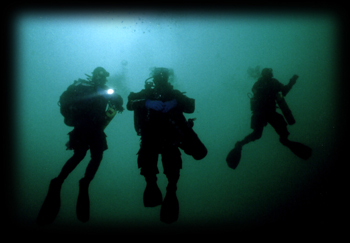
dives we would have plenty of time and back gas for the two dives. Our plan
was to check the starboard cargo hold for the two boxes, then if there was
time, to jump over to the port side and check out the old cars.
between
dives we would have plenty of time and back gas for the two dives. Our plan
was to check the starboard cargo hold for the two boxes, then if there was
time, to jump over to the port side and check out the old cars.
We entered the cold water with no real problems and once we were all together and did a quick bubble check, we headed down to the wreck. The down line was attached to the wreck at the bow and because of some great visibility we could see almost to amidships. We dropped quickly over the rail and headed down to the break in the hull that would take us into the starboard cargo hold. With one more quick check to confirm that everyone was O.K., we headed inside. The first thing we ran into was the crate of shoes near the entrance. I noticed someone had pulled one of the shoes out of the crate to get a better look and destroyed it since the last time we were there. It was disappointing. We moved along through a bulkhead and to the area where the two boxes were. When I finally saw them I started to chuckle. Last fall when I shot the video of course, as usual, I used my wide angle lens. Our two potential treasure chests were nothing more then two large cooking stoves that looked smaller in the pictures. Jane seeing the same thing, signaled for us to turn around and leave. Just as I turned to follow them out I noticed a large crack in the wall at the bow end of the cargo hold. I couldn’t squeeze in, but could see a fire hose hanging vertically. I reached my camera inside for a shot before I left. Viewing the video later the next room turned out to be the coal bunker with coal strewn about the floor.
We excited the starboard hold and quickly
crossed over the amidships deck. Dropping down the other side of the wreck
we located the port cargo hold where the old cars were. After another quick
check that everyone was O.K. with their air and bottom time, we slipped in.
The last time Jane and I were in this area we slowly swam straight through
and excited through a tight opening in the main deck. To our surprise and
dismay, during the winter, this upper main deck area had collapsed down on
the cars and now was impassable. To make matters worse, while we were on the
other side of the wreck, some other divers must have entered this area and
when turning around to exit, they kicked up the silt, pretty much killing
the visibility. We carefully edged a little way inside so I could at least
attempt to point out the cars with my camera spotting light, but it was mostly
to no avail. Carl later said he didn’t see them clearly, but was content to
turn around when we did. It was time to start heading up. We swam to the bow
and started our ascent. At 70 feet we all switched 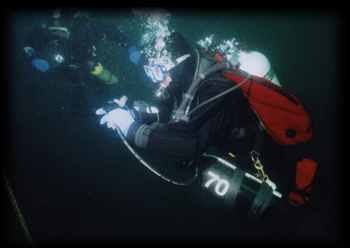 to our 50% stages and continued our decompression.
I noticed a slight mildewy taste to the air in my stage but didn’t give it
much thought. I know the gases were correct because of my double checking
them earlier. I continued to run the deco timing, giving signals when it was
time to go up to the next stop which was, in turn, confirmed by the other
two. This is the most boring part of a dive; you just hang there staring at
each other and wait for the minutes to go by. Carl decided to use this time
to practice air drills. An air drill is a procedure used to practice reaching
behind your head to open and close the isolation valves on your tanks. In
the case of a regulator malfunction or an over pressurization of your tank,
you can quickly close the offending valve(s) allowing you to conserve as much
air in your tanks as possible. Soon Jane joined him in his practicing. Once
we were all safely back in the boat, I commented that Carl seemed to do this
sometimes difficult maneuver with no problem. He said because he had longer
arms he had never had trouble reaching back. Images of Jane and me in a quarry,
years before, face down in the muck with gravel cutting our faces trying to
reach back and close those damn valves on our first attempt, made me grin.
I kidded, “If I ever need to close a valve, I’ll reach back…… point, and have
Jane do it!” Little did I know…
to our 50% stages and continued our decompression.
I noticed a slight mildewy taste to the air in my stage but didn’t give it
much thought. I know the gases were correct because of my double checking
them earlier. I continued to run the deco timing, giving signals when it was
time to go up to the next stop which was, in turn, confirmed by the other
two. This is the most boring part of a dive; you just hang there staring at
each other and wait for the minutes to go by. Carl decided to use this time
to practice air drills. An air drill is a procedure used to practice reaching
behind your head to open and close the isolation valves on your tanks. In
the case of a regulator malfunction or an over pressurization of your tank,
you can quickly close the offending valve(s) allowing you to conserve as much
air in your tanks as possible. Soon Jane joined him in his practicing. Once
we were all safely back in the boat, I commented that Carl seemed to do this
sometimes difficult maneuver with no problem. He said because he had longer
arms he had never had trouble reaching back. Images of Jane and me in a quarry,
years before, face down in the muck with gravel cutting our faces trying to
reach back and close those damn valves on our first attempt, made me grin.
I kidded, “If I ever need to close a valve, I’ll reach back…… point, and have
Jane do it!” Little did I know…
While we rested in the boat keeping hydrated with some bottled water, we started to figure out our next dive. Since our first 25 minute dive plan went off without a hitch we should be able to do our planned second 20 minute dive also with no problem. My sinuses were starting to get stuffed up a little but I figured it must just be a little too much lake water. Since we would be doing at least an hour of surface interval, Captain Jerry took advantage of the down time to do a short dive of his own. When he came back he told us he found an unused lifeboat about 50 feet off the port rail. I thought it would make some great video and asked Jane and Carl if we could spend some time looking for it. No problem as long as we don’t lose the wreck was the reply. “Sounds good” I said. We calculated that by the time we finished copying our dive plan and backups on our slates we would have our one hour surface interval completed. This meant we could go with our original calculations for time and gas that we had made earlier. While we were gearing up on the stern of the boat, Jerry noticed one of my valves behind my head was closed and opened it. How it got closed I have no idea. After completing our surface interval, we again jumped into the 130 feet of cold water. Unknowingly I had just made my biggest mistake.
We again dropped down the line to
the wreck. Jane and Carl were ahead of me. Because my sinuses were now giving
me a quite a bit of grief, I was having a hard time 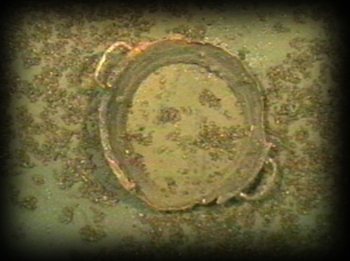 clearing
the pressure in my ears. I’d stop and blow, drop a little, stop and blow again,
drop some more and so on. Jane and Carl were starting to get out of sight.
I thought if I can’t fix this quick I’m going to lose them. No problem though,
if I do, I’ll just bail out, head to the surface and scrap this dive. After
quite a few more tries at clearing my ears I finally got them clear and caught
up to the other two. We left the port rail and headed away from the wreck.
Shortly I came upon an abandoned anchor and close by a cooking pot from the
Wisconsin’s galley. We still didn’t see the lifeboat and because we were starting
to stray quite a ways away from the wreck, Jane got a little nervous and turned
us back. She then led the way back to the wreck and toward the stern.
clearing
the pressure in my ears. I’d stop and blow, drop a little, stop and blow again,
drop some more and so on. Jane and Carl were starting to get out of sight.
I thought if I can’t fix this quick I’m going to lose them. No problem though,
if I do, I’ll just bail out, head to the surface and scrap this dive. After
quite a few more tries at clearing my ears I finally got them clear and caught
up to the other two. We left the port rail and headed away from the wreck.
Shortly I came upon an abandoned anchor and close by a cooking pot from the
Wisconsin’s galley. We still didn’t see the lifeboat and because we were starting
to stray quite a ways away from the wreck, Jane got a little nervous and turned
us back. She then led the way back to the wreck and toward the stern.
I casually looked down at my remaining
air and got a shock. I was down to 500psi of air!!! Close to nothing… How
could this be? Jerry must have closed my isolation valve instead of opening
it. I yelled for Jane through my regulator. (You can actually hear it on the
video tape through the camera housing.) Of course, neither she nor Carl could
hear me as they were several yards ahead. I quickly swam up gave them the
low on air signal and pointed to the regs behind my head. They reached my
valves tried to open them and signaled back that they were fine. Not believing
it I reached back and tried them myself. (It’s funny how I had no trouble
reaching the valves when it really counted.) They were definitely open. I
stopped to think for a minute. OK, I know I have plenty of 50% to use at 70
feet but it sure would be nice to use the line. Even now with only 450psi
in my doubles, I should still have enough to get back to the bow and up to
70 feet. I signaled I was heading back. Not waiting for a response, I swam
at a brisk pace back to the line. Jane and Carl followed behind me, just keeping
up. I knew I could share air with them if I totally ran out, but I felt pretty
sure I could make it to the bow. When I hit the line, our bottom time was
20 minutes. This was exactly our planned bottom time. Had I not had trouble
would we have over shot it? By then I only had 250 psi left in my doubles.
Not much, but enough to get to 70 feet. When we all ascended to the 70 foot
mark, we all made the gas switch and started our 3 minute stop. Again I could
taste that grass or mildew in my stage bottle. Now my sinuses kicked in full
throttle. My nose was running without stopping and I was constantly clearing
my mask. After 3 minutes were up I signaled to move up to the next decompression
stop. Both Jane and Carl looked at me as if to ask, are you sure? With all
the distractions I had mentally knocked off over a minute of our deco. At
this point, knowing I was having issues, Jane took over running the decompression.
The rest of the decompression went with out a hitch other then my sinuses
getting worse. While we were 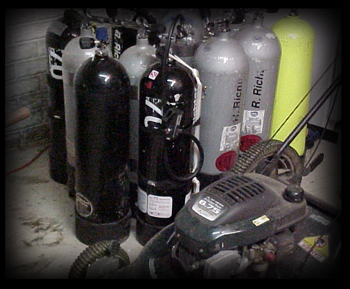 hanging there, I realized the reason for
the mildewy taste. When I finished rinsing my stage bottle and regulators
after last week’s dive, I set the still set up unit in the garage next to
the lawn mower full of grass. There must have been enough transference to
contaminate my mouthpiece and secondary regulator with grass or mildew. Soon
we were safely back in the boat with our gear stowed and our street clothes
back on.
hanging there, I realized the reason for
the mildewy taste. When I finished rinsing my stage bottle and regulators
after last week’s dive, I set the still set up unit in the garage next to
the lawn mower full of grass. There must have been enough transference to
contaminate my mouthpiece and secondary regulator with grass or mildew. Soon
we were safely back in the boat with our gear stowed and our street clothes
back on.
Though I knew in my arrogance of dive planning that I had gotten lackadaisical in checking my air during the dive, which is a problem I’ve never had since, believe me, I still couldn’t figure out why I didn’t have the amount of air I should have. It wasn’t until later that I figured out my major mistake. I never checked the pressure in my doubles after the first dive! I just used the plan we had made in the beginning without confirming that it was still viable. Again, not monitoring my air like I should have, I used more then I planned on the first dive and didn’t checked it later. Well, Mom, I’ve learned from my mistakes and by forwarding this to my friends and eventually the web site, I hope someone else can learn from it too. I’m fine, and diving a lot safer now.
See you soon,
Rick~~~